Ensuring financial sustainability is a core mandate for major water authorities like Melbourne Water in Australia and Metro Vancouver in Canada. To maintain operations, these entities must generate sufficient revenue to cover both day-to-day operating expenses and their fixed costs, which ultimately appear as charges on end-user utility bills. While Melbourne residents typically see these charges quarterly, the frequency for Vancouver ratepayers varies significantly depending on their specific municipality. A utility bill may not show this level of detail, but a portion of fees paid is dedicated to recovering the costs of construction and maintenance of wastewater treatment plants. To help authorities efficiently determine the impact of these costs on customers, water authorities group their costs and apply pre-determined rules to apportion charges.
Cost Groups at Melbourne Water
In relation to its sewerage services, Melbourne Water generally categorizes its charges into three primary cost groups:
- Bulk Sewage Transfer: This is the cost of transporting sewage from its source to a treatment facility. This is typically a variable charge based on the number of megaliters (ML) transferred.
- Treatment and Contaminant Removal: These charges cover the expense of treating large volumes of sewage and removing specific contaminants. For instance, Melbourne Water collects a fee per megaliter treated, as well as per tonne of biochemical oxygen demand (BOD), total suspended solids (TSS), total kjeldahl nitrogen (TKN), and inorganic total dissolved solids (TDS) removed.
- Fixed Costs: Often the largest component, these fixed costs cover the shortfall of the authority’s revenue requirements that otherwise would not be accounted for through the above variable charges. The cost of capital expenditure on infrastructure is often reflected in this cost group. An example is the construction of new Resource Recovery and Re-use Complex (RRRC) at Melbourne’s Western Treatment Plant,
Cost Groups at Metro Vancouver
Metro Vancouver, however, has adopted a different set of groups for its charges for the purpose of allocating costs. The apportionment mechanism is set out in detail in the Greater Vancouver Sewerage and Drainage District Bylaw Number 283, 2014. A detailed look at this bylaw reveals that the charges broadly fall within one of the following cost groups:
- Capital Infrastructure Projects: also known as Tier II projects, these projects are treated differently for the purpose of apportionment depending on whether they are classified as ‘growth’ projects or not. Construction of the new Northshore Wastewater Treatment Plant is an example of such capital infrastructure projects.
- Other Capital Projects: This is the cost of all other capital expenditures that fall outside the infrastructure grouping.
- Operation and Maintenance Costs: This is the cost of operating and maintaining treatment plants.
Cost Apportionment in metro Melbourne
In metropolitan Melbourne, the management of sewage is defined by a unique relationship between Melbourne Water and three independent “retail” water authorities: South East Water, Yarra Valley Water, and Greater Western Water. These retail entities act as the interface for the end-user, responsible for collecting bulk sewerage charges and remitting them to Melbourne Water. Each of these ‘retail’ water authorities service a defined geographical area and operate their own network of treatment plants. Melbourne Water, on its part, uses these funds for its operation and construction activities at its two major treatment facilities with an ability to divert incoming flow to either treatment facility.
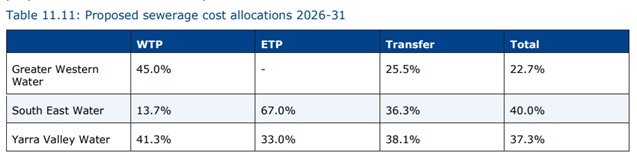
The underlying principle in Melbourne Water allocating costs to each retail water authority, and therefore a geographical area, is the use of actual usage data. In its most recent 2026 price submission to the Essential Services Commission (ESC), Melbourne Water proposed a new mechanism that would use the actual usage within the previous 5-year period to fix allocations for the next 5 years. This practice ensures that the costs of large infrastructure projects are distributed according to the demand each service area places on the system. Table 1 shows a summary of the proposed apportionment for the fixed charges:
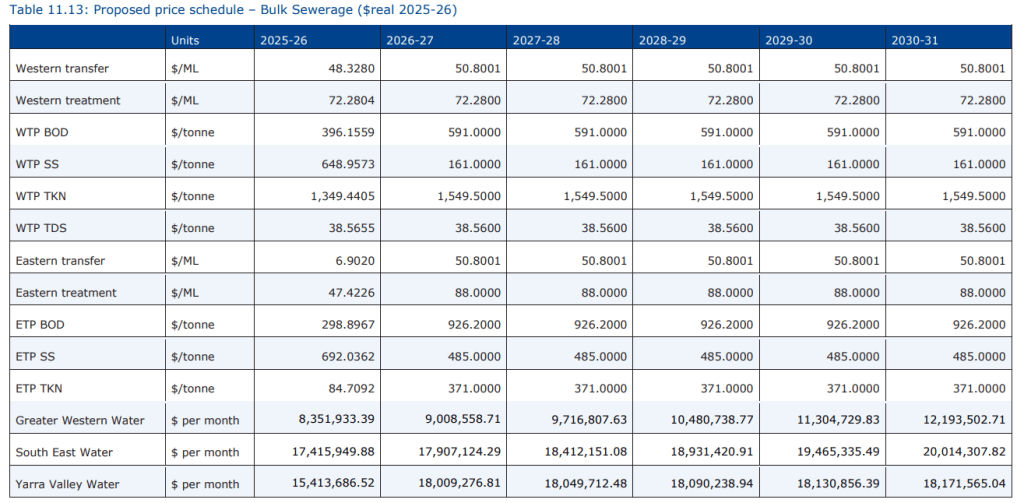
To provide further certainly for charges that would be passed on to each service area, Melbourne Water presents its plans in 5-year cycles to ESC. Once the plan is endorsed, the variables and fixed charges are established for the following 5 years. Table 2 shows the proposed charges for the 2026-31 pricing cycle.
Cost Apportionment in Greater Vancouver
In contrast to Melbourne’s approach, Metro Vancouver manages its apportionments through a more direct and localized framework. The region is divided into four distinct Sewerage Areas: the Fraser, Lulu, North Shore, and Vancouver Sewerage Areas. With the exception of the Fraser area, which relies on two separate plants, each service area is primarily dependent on its own wastewater treatment facility with limited capacity for cross-connection or flow diversion.
The backbone of Metro Vancouver’s system is a ‘cost-sharing formula’ which differs from Melbourne’s model in several key ways:
- Instead of relying heavily on metered usage or specific contaminant loads, Vancouver’s formula attributes costs based on ‘attribution’ and a complex mix of dry weather flows, land value, community benefit, and projected population growth.
- Because municipalities are largely tied to their specific local plant, they often bear the primary financial weight of projects within their own service area. Once Metro Vancouver determines these apportionments, the individual municipalities become responsible for collecting the necessary charges from their residents.
- The cost sharing formula is established by an act of Greater Vancouver Sewerage and Drainage District (GVS&DD) Board of Director without an input from public or oversight from an economic regulator.
This approach has led to significant debate over its fairness and affordability. To address these concerns, Metro Vancouver was forced to amend its bylaws. In 2024, a special provision was enacted via Bylaw No. 384 specifically to redistribute the significant costs of the Northshore Wastewater Treatment Plant (NSWWTP) more broadly across other municipalities. This acknowledges that the standard formula may not be appropriate in certain special cases.
Despite this accommodation, some municipalities remain dissatisfied with the special apportionment arrangement. This is because unlike the autonomous retail authorities in Melbourne, Vancouver’s municipalities have limited ability to reduce their reliance on the regional system by building their own localized plants, making them more vulnerable to the costs of large-scale regional projects.
Comparison Summary
While both Melbourne and Vancouver face the immense financial pressure of upgrading aging infrastructure to meet the demands of growing populations, the divergent ways they allocate these costs reveal fundamentally different regulatory and operational realities. The following comparison highlights the primary drivers that differentiate these two models:
| Feature | Melbourne, Victoria (Australia) | Vancouver, British Columbia (Canada) |
|---|---|---|
| Operational Control | High ability to divert flows across the sewer network to balance load and flow | Limited control; service areas are largely ‘siloed’ by river systems and topography |
| Financial Oversight | Regulated by the Independent Essential Services Commission (ESC) | Charges are set directly by Metro Vancouver through regional bylaws |
| Cost Allocation Basis | Primarily based on actual metered usage and contaminant loads (BOD, TSS, etc.) | Based on ‘attribution’ and a complex formula including dry weather flow, land value, and population growth |
| Regional Autonomy | Retail authorities can build local plants to reduce reliance on the central system | Municipalities have limited autonomy to build independent localized treatment facilities. |
Related Posts:
 QANAT
QANAT 