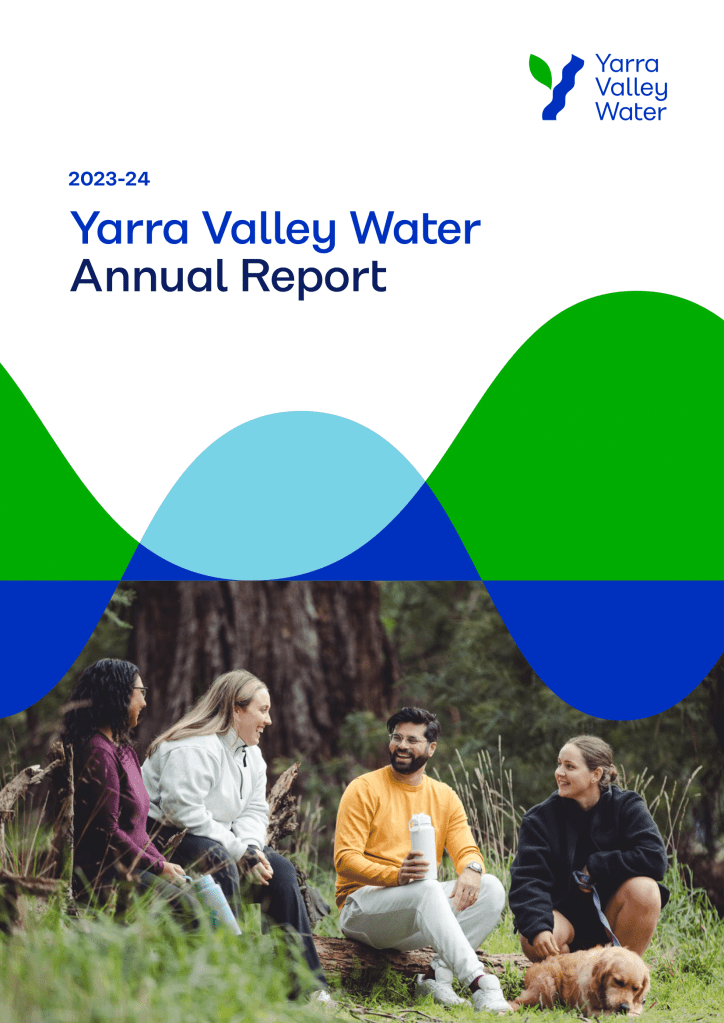
This third installment of my review of the Victorian Metro water utilities focuses on Yarra Valley Water (YVW). Previously, I have examined the annual reports for Melbourne Water and Greater Western Water for the same reporting period. In this review, I will use the same template as in my earlier posts, concentrating on Governance, Key Performance Indicators and Financial results.
Please note that while I have attempted to draw comparison between water authorities, these comparisons are not comprehensive. Each review has been conducted in the order they appear on my blog and in isolation. Therefore, while I might compare YVW with Melbourne Water and GWW previously reviewed, I will not be able to do the same comparison with those I will review in the future such as South East Water.
Governance
During this reporting period, YVW experienced several changes to its board composition, appointing new members Gabrielle Bell, Mary Kanavoutos and Robyn McLeod AM. Gabrielle Bell will succeed Sue O’Conner as the chair of the board. Retiring members include Helen Thornton and Ian Hamm. Through these transitions, YVW maintained its board membership at the maximum of nine.
The board, together with the managing director, received a total remuneration of $1.11 million during the reported financial year. The lion share of this sum usually belongs to the managing director, Patrick McCafferty, who received a pay rise placing him in the $530,000 to $539,999 pay bracket. Appointed as managing director on 1 July 2014, Patrick announced he will be stepping down in 2025 after nearly 11 years of service.
The annual report disclosed the following related party transactions:
- Outgoing member of the board, Mary Kanavoutos is Jacob’s ANZ market Director – Water, with which YVW has an ongoing long term contract. During this financial year, YVW received invoices totalling $15.8 million from Jacobs for its services.
- Incoming board chair Gabrielle Bell’s spouse is a Partner at Deloitte. YVW received invoices totalling $1 million during this financial year for engaging Deloitte’s services.
To be clear, there is no suggestion of any inappropriate behavior has taken place. All board members are appointed by the Minister of Water. YVW and all other Victorian water authorities are required to disclose such transactions under their disclosure obligations to improve transparency with the public.
Key Performance Indicators
YVW demonstrated strong financial performance during this reporting period, generally achieving its targets, with the notable exception of ‘current ratio’. A higher current ratio typically indicates a stronger asset value relative to current liabilities. While YVW aimed to increase its current ratio from 31.16% in the previous financial year to 35.84% this year, it instead decreased to 29.68%, falling 17.2% short of its target. This suggests that YVW has taken on additional liabilities compared to its current assets. It is important to note that ‘current ratio’ targets vary significantly across water corporations due to geographical factors and the scope of their mandate, with examples like GWW targeting 60% and Melbourne Water targeting 18%.
YVW also fell short of its operational performance target for maintaining a reliable water supply. The target was for an average customer to experience only 11.55 minutes of off-supply time during planned activities. However, the reported interruptions time was 20.54 minutes, exceeding the target by 77.8%.
Despite these shortcomings, YVW demonstrates a commitment to accountability. In its 2023-28 Price Submission, YVW adopted a rebate program, allocating $1.8 million for each performance outcome not achieved. This program encompasses 17 measures relating to safe and pleasant drinking water, reliable water and sewerage services, timely response and repair, service that meets everyone’s needs, water conservation, and environmental protection.
YVW failed to meet targets for the following measures:
- Customers who agree we provide great drinking water (Target:91%; Result:86%)
- Water lost from Yarra Valley’s supply system (Target:7.8%; Result:10%)
- Recycled water used in areas where it’s available (Target:3.7%; Result:1.1%)
- Volume of sewage spills reported to the EPA as having significant impact to the environment (Target:<5000kL; Result:9348kL)
While acknowledging the subjective nature of customer perceptions regarding drinking water, other missed targets were linked to maintenance and critical upgrades at Brushy Creek and Aurora Recycled Water Treatment plants. These plants are expected to return to service February and September 2025, respectively. As a result of these missed targets, YVW has committed to paying $3.39 million in rebates to its customers.
In terms of safety, YVW reported a Total Recordable Injury Frequency Rate (TRIFR) of 3.54 as of June 2024, making it the safest water corporation amongst its peers reviewed to date. This compares favourably to Melbourne Water’s TRIFR of 7.6 and GWW’s TRIFR of 9.1.
Financial Report
In its 2023-28 Price Submission, YVW projected a required revenue of $1,002,400,000 for the 2023-24 financial year to efficiently provide services to its customers and provide a return to its shareholder. However, YVW’s annual report shows a total revenue of $1,238,676,000 exceeding its projection by 24%. With a total of 821.8 full-time equivalent (FTE) employees and a net profit before tax of $194,157,000, YVW generated a profit of $23,625,820 per 100 FTE employee.
YVW’s total capital expenditure for this reporting period reached $367 million, significantly surpassing the $329.88 million forecast in its Price Submission. With contractual commitments of $327.28 million for the next 12 months, YVW is on track to meet, and potentially exceed, its projected capital expenditure of $394.53 million for the 2024-25 financial year.
In 2023-24, YVW spent a total of $1,237,142.54 on consultancies. A significant portion of this, $853,390.05, was allocated to cultural heritage management plans for infrastructure projects and cultural advisory services with the Wurundjeri Woi-Wurrung Cultural Heritage Aboriginal Corporation. However, the total consultancy expenditure is likely considerably higher, as YVW has not disclosed spending on its some consultants, such as Jacobs and Deloitte, noted previously in related party disclosures. This undisclosed amount could be as high as an additional $16.8 million, bringing the total consultancy expenditure to $18.3 million.
Resources
Yarra Valley Annual Report 2023-24 (PDF)
Yarra Valley Water Consultants Engaged 2023-24 (PDF)
Yarra Valley Water Price Submission 2023-28 (PDF)
Yarra Valley Water Financial Data 2023-24 (Excel)
 QANAT
QANAT 
One thought on “Review of Yarra Valley Water (YVW) Annual Report 23-24”