Why this report is being produced?
Parliamentary documents1 prepared in the lead-up to the enactment of the new Water Industry Act 1994 indicate that the establishment of three metropolitan retail water corporations was intended, in part, to enable a degree of service comparison for customers. As these corporations do not directly compete for customers, such comparisons provide an important mechanism for accountability and performance assessment. This report aims to facilitate that comparison by examining the operations of each water corporation, serving as a point of reference for both customers and industry stakeholders.
Where is the information being sourced from?
All information presented and calculated in the table below is derived from the publicly available annual reports of each water corporation for the 2023-24 financial year. Any figures sourced externally are clearly indicated by a corresponding footnote.
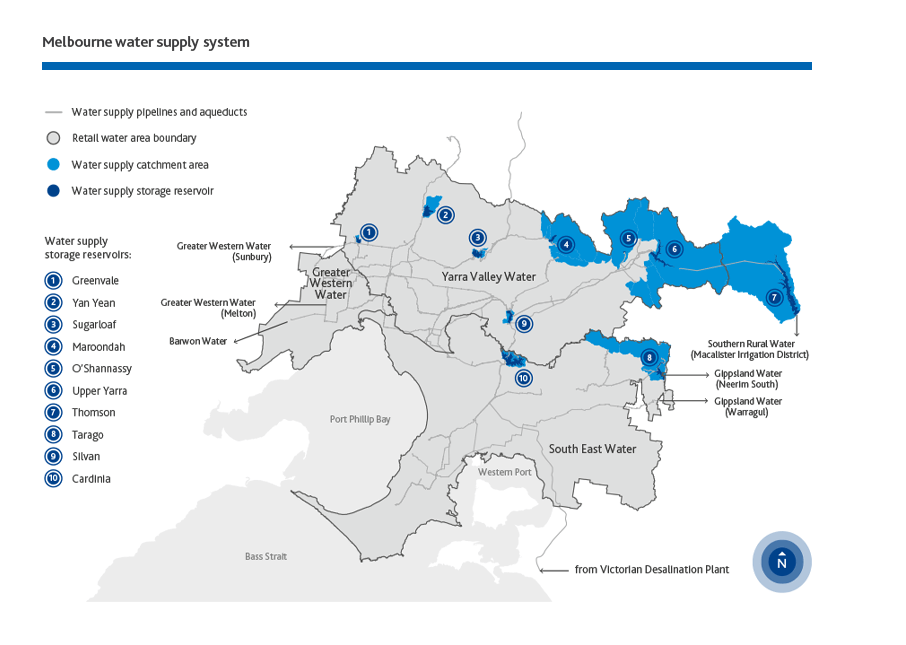
| Indicator | Melbourne Water (MWC) | South East Water (SEW) | Yarra Valley Water (YVW) | Greater Western Water (GWW) | Commentary |
| CORPORATE | |||||
| Number of Employees (Full-time Equivalent) | 1,324.10 | 837.4 | 821.8 | 793.7 | MWC is the largest employer in metro Melbourne. |
| Annual revenue ($ million) | $2,040.3m | $1,143.4m | $1,238.6m | $993.4m | Most of MWC’s revenue is derived from sale of bulk water to SEW, YVW, GWW |
| Annual revenue per employee ($ million) | $1.54m | $1.36m | $1.50m | $1.25m | The industry average revenue per employee for utilities in AU/NZ according to IBIS World is $1.02m by which standard all water utilities in metro Melbourne are performing above this industry average.2 |
| Board remuneration ($ million) | $1.14m | $2.79m | $1.11m | $1.06m | Higher renumeration attributed to SEW is likely due to members serving on two separate boards of SEW and Iota. |
| Managing Director remuneration (Band) | $610,000-$619,999 | $490,000– $499,999 | $530,000-$539,999 | $480,000-$489,000 | It is possible that MWC and YVW Managing Directors receive higher remuneration due to achieving higher profits and scale of their operation |
| Consultancy expenditure ($ million) | $2.1m | $2.6m | $1.1m | $6.6m | Indicating GWW is the most reliant on consultants. It must be noted that each corporation defines consultant expenditure differently. |
| CAPITAL EXPENDITURE | |||||
| Total value of assets under management | $18,238.7m | $5,507.5m | $6,458.9m | $4,189.8m | MWC is the largest asset owner given the scale of their operation. YVW is the second in line amongst other water corporations. |
| Total capital expenditure ($ million) | $746.0m | $301.1m | $367.0m | $297.0m | In line with the value of assets, MWC is the largest investor in its infrastructure. |
| Capital expenditure (investment) over the total asset base (%) | 4.10% | 5.50% | 5.70% | 7.10% | GWW has the highest investment program over its asset base, likely due to aging infrastructure and population growth in their operational area. |
| Proportion of capital expenditure (investment) being self-financed (%) | 76.70% | 11.20% | 19.60% | 0% | The bulk of projects are being self-financed by MWC while GWW is entirely dependent on external funding sources such as those borrowed from the State Government |
| SAFETY | |||||
| Total Recordable Injury Frequency Rate (injuries per million work hours) | 7.1 injuries | 9.51 injuries | 3.5 injuries | 9.6 injuries | YVW appears to be the safest workplace. It must be noted that each corporation is at a different level of sophistication in reporting injuries. |
| Reticulated Potable Water Mains | |||||
| Reticulation pipeline under management (km) | Melbourne Water does not manage reticulation pipework | 14,6393 | 7,5004 | 9,1805 | SEW maintains the largest reticulation network in South East Melbourne consistent with the large population it serves in the region. |
| Drinking water leakage through reticulated network (ML) | Not applicable | 15,409ML | 9,042ML | 13,000ML | SEW loses the most potable / drinking water through its network with GWW a close second. |
| Drinking water leakper 100 km of water main (ML) | Not applicable | 105.26ML | 120.56ML | 141.61ML | GWW operates a reticulation system that experiences the most leaks per 100km of water mains explaining the higher investments on its asset base. |
| SEWER MAINS | |||||
| Sewer Spills per 100 kilometers of sewer main (no.) | No sewer spills reported for 2023-24 period | 6.3 | 15.1 | 4.2 | YVW experienced the most leaks through its sewer network 2.5 times more than that of SEW. |
| Containment of sewer spills within 5 hours (%) | No sewer spills reported for 2023-24 period | 98.6% (target: 100%) | 99.7% (Target: 98.7%) | 99% (Target: 100%) | YVW has been able to contain its larger number of spills within 5 hours while SEW remains the worst performer in this metric amongst other metro retail water corporations. |
| WATER QUALITY | |||||
| Customer Water Quality Complaints (number of complaints per 100 customers) | Melbourne Water does not sell water directly to customers | 0.28 (target: 0.18) | 0.36 (target: 0.46) | 0.28 (target: 0.19) | YVW received the highest number of complaints about its water quality. |
| RECYCLED WATER | |||||
| Recycled water production as a proportion of effluent produced (%) | 36,649ML recycled | 28.3% (Target: 23%) | 18.8% (Target: 30.5%) | 41.6% (target: 40%) | GWW is leading the way in its production of recycled water amongst other metro retail water corporations. |
| RENEWABLE ENERGY | |||||
| Onsite renewable energy generated and consumed (MWh) | 151,593MWh (Source: Biogas, Hydroelectric, Solar) | 19,621MWh (Source: Biogas, Hydroelectric, Solar, Wind) | 1,378MWh (Source: Biogas, Solar) | 2,347MWh (Biogas, Solar) | Most of MWC generation is sourced from biogas, while bulk of SEW generation is sourced from wind. YVW’s Waste to Energy plants were offline during this reporting period. |
| Total power consumption (MWh) | 342,073MWh | 31,924MWh | 28,609MWh | 34,725MWh | Melbourne Water is the largest consumer of power due to the large scale of their operation. |
| Power consumption sourced from self-generated renewable sources (%) | 44.3% | 61.5% | 4.8% | 6.8% | SEW has a target to achieve net-zero by 2030 and appears to be on route to achieve that target. |
Footnotes:
- Water Industry Bill 1994 Second Reading Speech – Lower House, Page 1849. ↩︎
- IBISWorld Industry Average referring to the average of all companies in the AU & NZ Enterprise Profiles database that are identified as primarily operating in the Water Supply industry. Accessed 29 May 2025. ↩︎
- South East Water Annual Report 2023-24, Page 13. ↩︎
- Yarra Valley Water Price Submission 2023-28, September 2022, Page 182. ↩︎
- Greater Western Water Annual Report 2023-24, Page 5. ↩︎
 QANAT
QANAT 