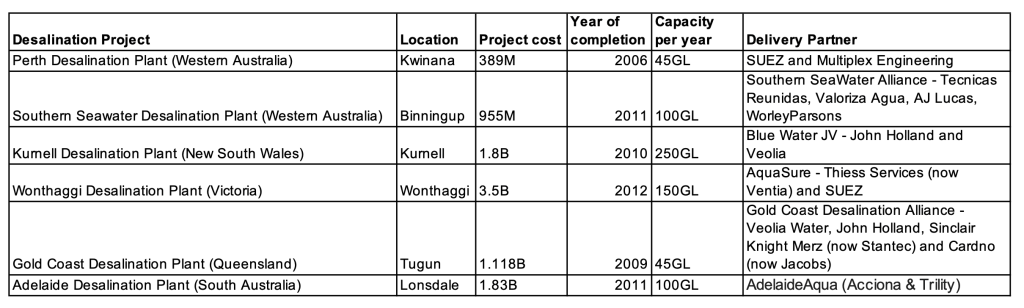
The utilisation of desalination technology to purify seawater for human consumption and other purposes has been a game-changer for the water industry. This process involves removing salt and other minerals from seawater, making it suitable for drinking and a variety of other uses. Australia has been at the forefront of this technology, with numerous desalination plants in operation across the country, particularly in Western Australia, New South Wales, Victoria, Queensland, and South Australia. The majority of these plants are small-scale facilities that cater to the needs of local communities, tourist destinations, and various industries. Despite studies demonstrating the need for these mega public infrastructure projects, rushing into procurement without consultation can have a detrimental effect on their users. One notable example is the Wonthaggi desalination plant in Victoria, which is the most recent major desalination facility built in Australia and was the largest public sector infrastructure project at the time of its construction in 2012.

The implementation of the Wonthaggi desalination plant was executed through a Public-Private Partnership with AquaSure, with an estimated capital cost of $3.5 billion. The partnership includes an annual security payment to AquaSure, ranging from $650 million to $800 million, to operate and maintain the facility until 2039. It is noteworthy that this operational cost is incurred regardless of the plant’s water production. In addition to this, there is a production cost of $100 million to $200 million that will be incurred when the plant is operating at full capacity. Despite the plant’s capability to deliver 150 gigaliters of water, it has only produced 451 gigaliters in the six years between 2016 and 2022, which is only 50% of its capacity over this period.
AquaSure is a joint venture partnership between SUEZ and Ventia (formerly known as Thiess Services), with SUEZ providing design services and Ventia responsible for operating the Wonthaggi desalination plant until 2039. Technology provider Degrémont was also involved in the project in a joint venture arrangement with Thiess Services.
The Wonthaggi desalination plant, despite its potential benefits, has been a source of controversy. Before its construction, the project faced legal challenges from the community group ‘Your Water Your Say’ claiming inadequate public consultation and environmental impact assessment.1,2 Additionally, some have criticised the high energy consumption and high costs associated with desalination as a water source. The justification for the project’s construction was based on the effects of climate change predicting more dry weather, which has not been a pressing issue in Victoria since the drought years, leading to doubts about the wisdom of such a costly investment. In 2013, Dr Ron Ben-David, the head of Essential Services Commission, criticised Melbourne Water’s decision to pass on the security payments directly to customers over a 27-year period, instead of spreading them over the plant’s effective lifespan of 50 years. This latter option would have both reduced costs for customers and spread them over a larger pool of customers as Victoria’s population increases. This is not today that things have not changed since. The community consultation processes around public projects and their impact on water pricing have improved significantly. Furthermore, Melbourne Water took steps in its 2016 submission to reduce costs to its end users by capitalising and spreading some of the costs over a longer period as Dr Ron Ben-David had hoped for in his report.
It is important to note that community consultation is crucial throughout all stages of financing and delivery of major infrastructure projects. The example of the Wonthaggi desalination plant highlights the importance of engaging with the community and addressing their concerns, in order to ensure that the project is not only technically feasible, but also socially and economically viable. Effective community consultation can help to mitigate potential challenges and ensure that the infrastructure project is beneficial for all stakeholders.
References:
[1] Your Water Your Say Inc v Minister for the Environment, Heritage and the Arts [2008] FCA 670 (16 May 2008)
[2] Your Water Your Say Inc v Minister for the Environment, Heritage and the Arts (No 2) [2008] FCA 900
Other resources:
Victorian Desalination Project Environment Effects Statement
 QANAT
QANAT 
One thought on “The Wonthaggi Experience”